Refractive Lens Exchange · Femtosecond Laser · Colchester, Essex
Lens Replacement Surgery in Essex
Laser-assisted lens replacement for lasting spectacle freedom, led by Mr Hatch Mukherjee — a refractive surgeon whose focus is optimising vision, not simply removing a cloudy lens. Bilateral surgery, multifocal lenses and aftercare as standard.
Professional memberships, fellowships & leadership roles



Permanent Spectacle Freedom — Without Waiting for Cataracts
Lens replacement surgery — also called refractive lens exchange (RLE) or clear lens extraction — replaces the eye's natural lens with a premium intraocular lens (IOL). Unlike laser eye surgery, which reshapes the corneal surface, lens replacement works from inside the eye and is permanent: the implanted lens will never develop a cataract.
It is particularly well-suited to patients in their 40s, 50s and beyond who want to reduce or eliminate their dependence on glasses, including reading glasses — and for whom corneal laser surgery may not be the optimal approach. The natural lens that is removed is the same one that would eventually form a cataract, so patients also eliminate that future risk entirely.
Ideal for patients over 45
As the natural lens stiffens with age (presbyopia), laser eye surgery alone cannot address reading vision. Lens replacement treats the root cause directly — replacing the lens itself.
Permanent — no future cataract
The artificial IOL cannot develop a cataract. Patients who choose lens replacement now will not need cataract surgery later in life — a significant long-term advantage.
High prescriptions
For patients with very high prescriptions outside the optimal range for corneal laser, or where corneal anatomy makes laser less suitable, lens replacement often delivers superior outcomes.
Both eyes, both distances
With the right multifocal or extended-range lens, most patients achieve good vision for distance, intermediate screens and near tasks — without glasses for the majority of activities.
There Are Many Cataract Surgeons. Fewer Specialise in Spectacle Freedom.
A general cataract surgeon’s primary goal is to remove a cloudy lens safely and restore functional vision — a task they do very well. But when the goal is spectacle freedom, the approach, lens selection and mindset need to be fundamentally different. That requires a refractive surgeon.
A refractive surgeon optimises for spectacle freedom
When Mr Mukherjee plans lens replacement, the target is life without glasses — for distance, screens and reading. This influences every decision: biometry technique, lens selection, incision planning and target refraction.
Laser enhancement — an option most cataract surgeons cannot offer
Mr Mukherjee — being CertLRS-qualified — can offer LASIK or TransPRK as a precise enhancement after lens surgery, taking you the final step to spectacle freedom. This combined approach is called bioptics.
Precision biometry and lens selection
Premium multifocal and extended-range lenses demand the highest level of pre-operative planning. Mr Mukherjee maps the optical system of each eye individually to select the ideal lens power and design.
Refractive mindset from first consultation to final review
Your consultation focuses on your visual lifestyle — what you want to see without glasses and what trade-offs matter to you. This shapes a personalised lens plan, not a standardised protocol.
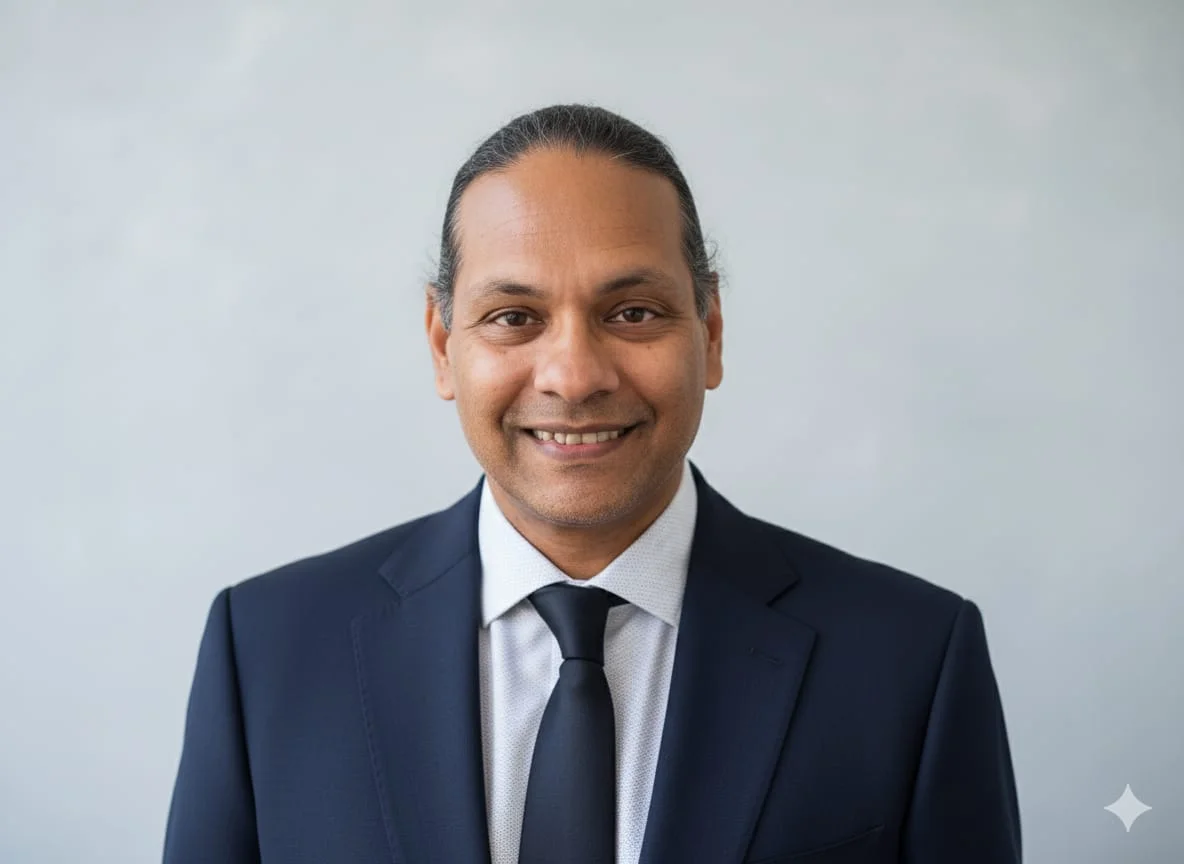
Spectacle freedom requires a refractive surgeon — not just a cataract surgeon.
Book a free consultation — discover The Vision Surgeon AdvantageFWCRS · CertLRS · Vision correction specialist · Colchester, Essex
98% of patients would recommend Mr Mukherjee.
Verified through PHIN — the independent Private Healthcare Information Network.
"I left reassured and confident in the consultant and well informed about the options available to me."
"The entire team made me feel at ease from consultation to aftercare."
"Innovative approach... my vision has surpassed both of our expectations."
Mr Mukherjee is fellowship-trained in both LASIK and TransPRK — and will recommend the right option for your eyes.
Book a free consultation — discover The Vision Surgeon AdvantageCertLRS · FWCRS · Refractive Fellowship · Consultant-led from first appointment to final sign-off
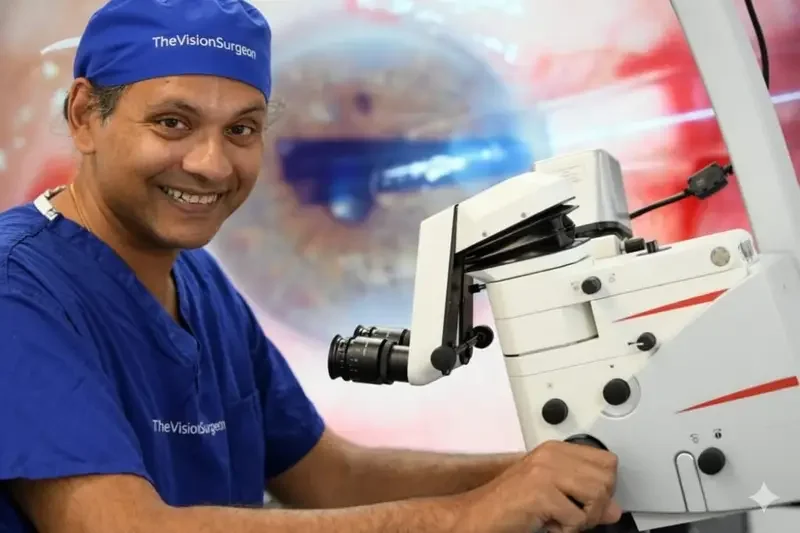
Laser Lens Replacement — Not Manual, and Why That Matters
Traditional lens replacement surgery is performed entirely by hand. The critical steps — creating the opening in the lens capsule and fragmenting the lens — rely on surgical freehand technique, with the inherent variability that entails.
Mr Mukherjee performs laser lens replacement using femtosecond laser technology. A highly precise laser performs the most demanding steps of the procedure with sub-micron accuracy — creating a perfectly circular, centred capsule opening and softening the lens before removal. This has direct consequences for how well a premium multifocal lens sits and functions inside the eye.
Perfectly centred capsulotomy
The lens capsule opening created by the femtosecond laser is circular, precisely centred and reproducible in a way manual techniques cannot match — critical for premium lens alignment and performance.
Less ultrasound energy inside the eye
Pre-softening the lens with laser before removal means significantly less phacoemulsification energy is needed, reducing stress on the internal structures of the eye.
Optimal conditions for premium lenses
Multifocal and extended-range lenses depend on precise centration and capsular support to deliver their full optical performance. The laser creates the most reliable environment for this.
Consistent results
Laser-assisted steps are not subject to the hand tremor or variability of freehand surgery. For patients choosing premium lenses with demanding optical precision, this consistency matters.
Not all lens replacement is laser lens replacement. Many surgeons perform the procedure manually. If spectacle freedom is your goal, it is worth confirming whether femtosecond laser will be used — and whether your surgeon routinely implants premium multifocal lenses.
Premium intraocular lenses
Lens Options: Choosing the Right Implant for Your Vision Goals
The lens implanted determines your visual outcome. Mr Mukherjee discusses each option in detail at consultation, based on your prescription, lifestyle, occupational needs and visual priorities. There is no single best lens — the right choice depends on the individual.
Trifocal / Multifocal Lenses
Designed to provide good vision at distance, intermediate (screens, dashboard) and near (reading, phone). The goal is spectacle independence across the full range of everyday tasks. Mr Mukherjee selects from the most clinically established trifocal platforms available.
Best for: patients who strongly prioritise spectacle freedom and have realistic expectations about night vision adaptation.
Extended Depth of Focus (EDOF)
EDOF lenses extend the range of clear vision from distance through to intermediate, with reduced reading glass dependence. They tend to have fewer visual side-effects (halos, glare) than trifocal lenses, making them well-suited to patients who prioritise optical quality and drive frequently at night.
Best for: patients who drive at night, work in low light, or want maximum optical clarity at the cost of some reading independence.
Premium Monofocal & Light-Adjustable
A premium monofocal lens delivers outstanding optical clarity at a single focal distance. With a monovision approach — one eye set for distance, one for near — useful functional range can be achieved while preserving high contrast and crisp optics. Light-adjustable lenses allow fine-tuning of the prescription after implantation.
Best for: patients in visually demanding occupations or those who prioritise optical quality over full spectacle independence.
How we do things differently
Bilateral Surgery & Laser Enhanced Surgery
Two features of Mr Mukherjee’s lens replacement programme that patients consistently value above others.
Both Eyes — One Visit
Many centres perform lens replacement on one eye, then ask patients to return weeks later for the second. Mr Mukherjee offers bilateral same-day or closely staged surgery — treating both eyes in a single visit where appropriate.
- Faster return to normal binocular vision
- One period of recovery rather than two
- Fewer visits to the clinic and less time off work
- Earlier spectacle freedom — without the imbalance of being corrected in only one eye
Bilateral surgery is discussed at consultation. In certain clinical situations, staged surgery remains the right approach — Mr Mukherjee will advise clearly.
Rapid Recovery - Laser not Manual
Traditional lens replacement surgery is performed entirely by hand. The critical steps — creating the opening in the lens capsule and fragmenting the lens — rely on surgical freehand technique, with the inherent variability that entails.
Mr Mukherjee performs laser lens replacement using femtosecond laser technology. A highly precise laser performs the most demanding steps of the procedure with sub-micron accuracy — creating a perfectly circular, centred capsule opening and softening the lens before removal. This has direct consequences for how well a premium multifocal lens sits and functions inside the eye.
Laser-assisted surgery. Premium lens options. Both eyes in one visit. This is The Vision Surgeon Advantage.
Book a free consultation — discover The Vision Surgeon AdvantageFemtosecond laser · Multifocal lenses · Bilateral surgery · Drop-free aftercare
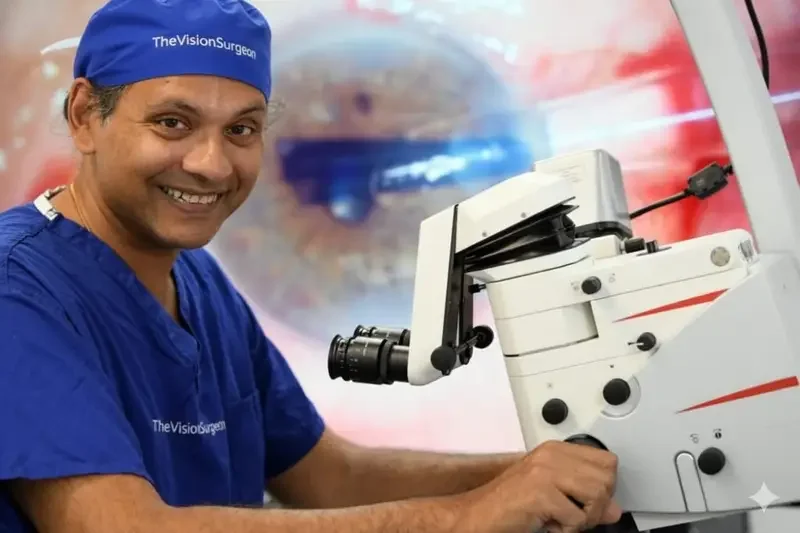
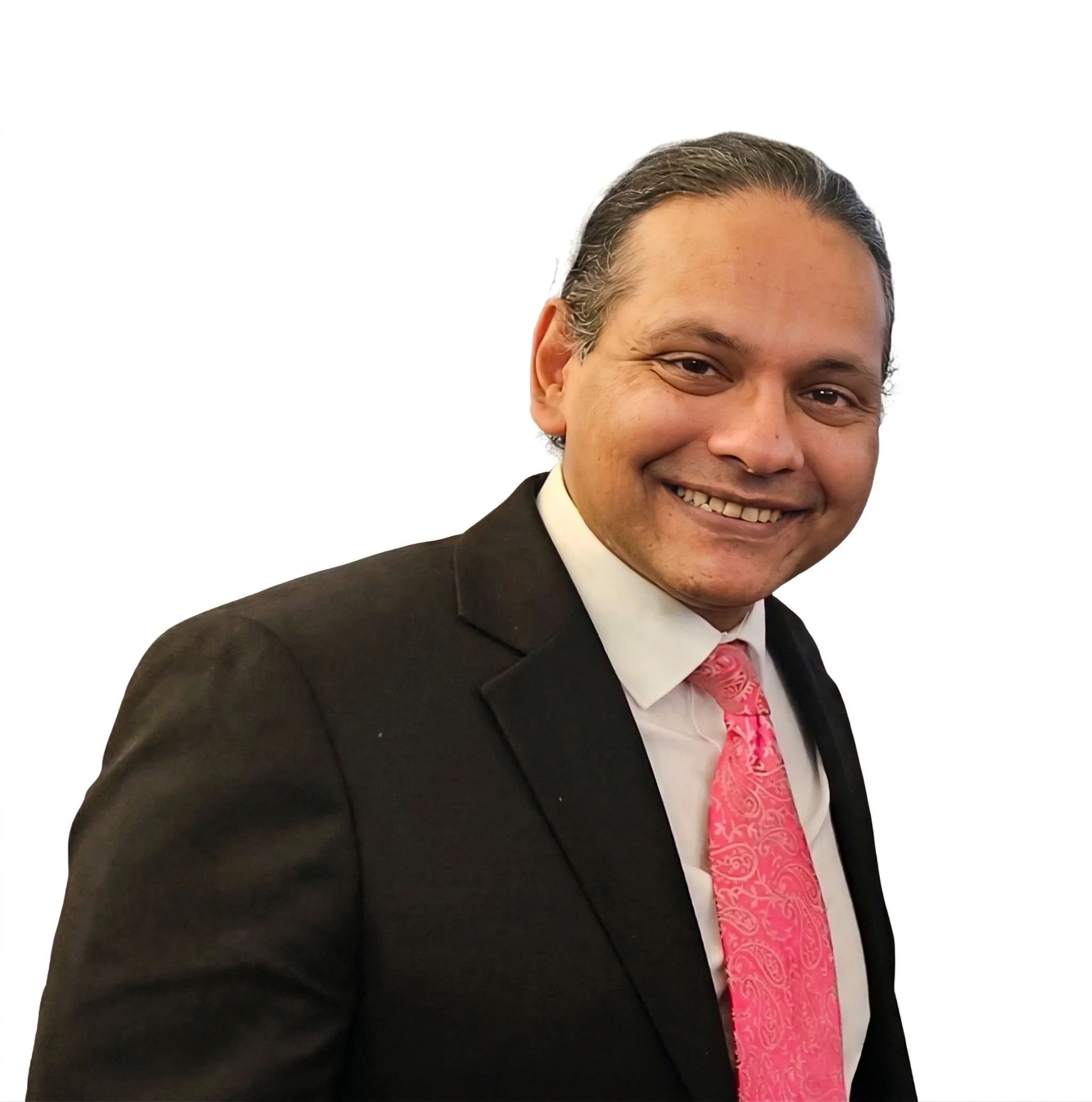
Mr Hatch Mukherjee — Refractive Surgeon & Lens Specialist
Mr Mukherjee is trained and credentialled as both a refractive surgeon and a lens and cataract surgeon — a combination that is directly relevant when spectacle freedom is the goal.
He holds the FWCRS (Fellow of the World College of Refractive Surgery), the CertLRS from the Royal College of Ophthalmologists, and completed three post-CCT fellowships including dedicated training in laser vision correction and advanced femtosecond laser cataract surgery. He is Clinical Lead for Ophthalmology at Colchester Eye Centre, ESNEFT.
FWCRS — World College of Refractive Surgery
International fellowship recognising distinguished expertise in refractive and vision correction surgery — lens and laser.
CertLRS — Royal College of Ophthalmologists
One of a select group of UK surgeons qualified in both laser and lens-based refractive surgery — enabling the full bioptics pathway if needed.
Femtosecond laser cataract fellowship
Advanced fellowship training in femtosecond laser-assisted lens surgery — not simply a skill acquired through volume, but through dedicated sub-specialist training.
You see the consultant throughout
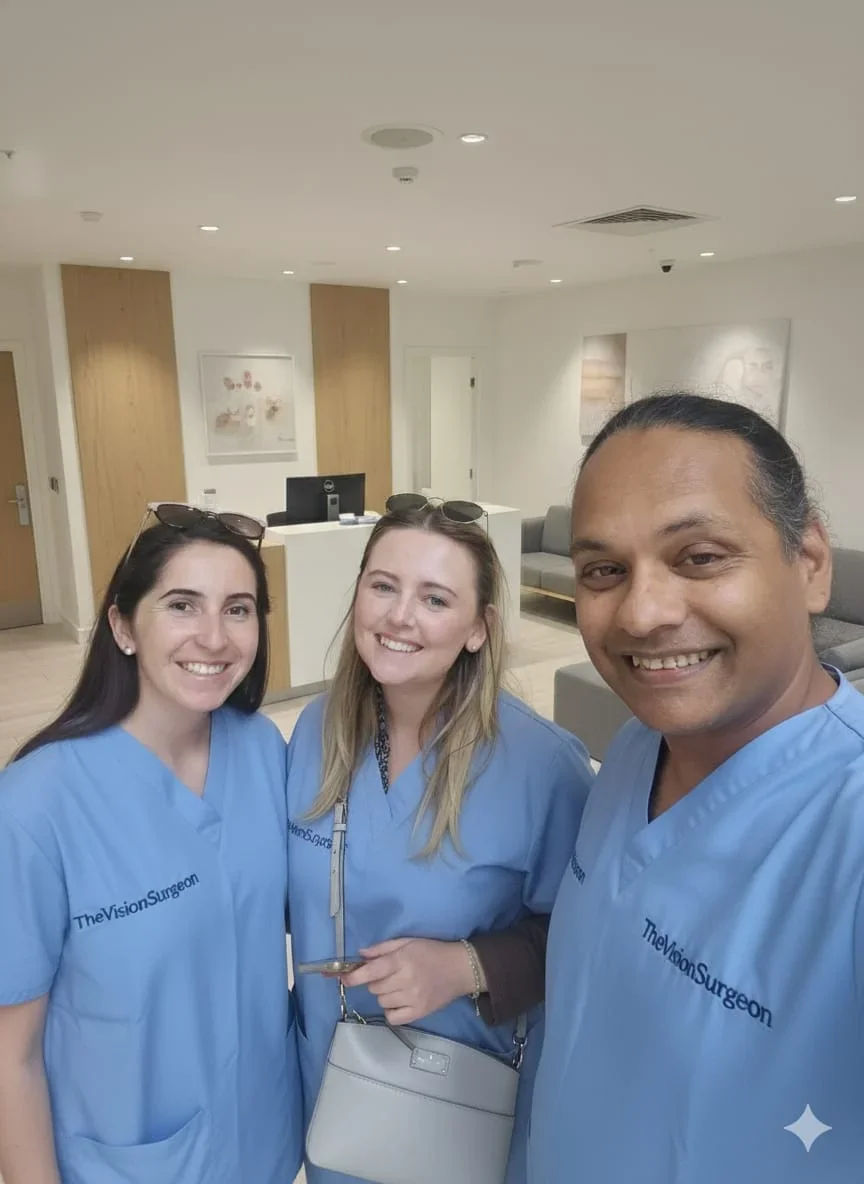
Assessment, biometry, surgery, laser enhancement (if needed) and follow-up are all personally led by Mr Mukherjee — not delegated to technicians or junior staff.

A vision correction specialist, not just a lens surgeon — from consultation to final result.
Book a free consultation — discover The Vision Surgeon AdvantageSame consultant throughout — assessment, surgery, laser enhancement if needed, and follow-up
What to Expect at Every Stage
- Suitability consultation — full corneal mapping, pachymetry, refraction and dry eye assessment. Mr Mukherjee discusses your options and answers all questions.
- On the day — anaesthetic drops are applied. You lie down and look at a fixation light. The laser treatment takes under 10 minutes per eye. There is no discomfort during the procedure.
- Immediately after — LASIK patients notice clearer vision within hours. TransPRK patients experience 3–5 days of surface healing during which vision is blurred.
- Follow-up — you are seen at 1 day (LASIK), 1 week and 1 month post-operatively. Most patients are fully signed off at the 3-month visit.
Frequently Asked Questions
RELATED TREATMENTS
Not sure laser is right for you?
If laser eye surgery is not suitable — due to a high prescription, thin corneas or other factors — there are excellent alternatives that Mr Mukherjee can discuss at consultation.
Implantable Contact Lens (ICL)
A collamer lens implanted behind the iris — ideal for high prescriptions or thin corneas unsuitable for laser treatment. Removable and reversible.
Lens Replacement (RLE)
Refractive lens exchange removes the natural lens and replaces it with a premium IOL. Addresses both vision correction and presbyopia simultaneously.
Cataract Surgery
For patients with a cloudy lens affecting vision. Premium lens options can reduce or eliminate the need for glasses after cataract removal.
Find out if laser eye surgery is right for you.
Mr Hatch Mukherjee provides expert suitability assessments and consultant-led laser eye surgery in Colchester, Essex. Your free consultation includes full corneal mapping and a clear, honest recommendation.